
Kandy to Ella Train: Complete Guide to Tickets, Seats and Scenery
24 October 2026 · 16 min read
The Kandy to Ella train is one of the most loved rail journeys in Asia, and for good reason. In roughly seven hours the line climbs from the old royal city of Kandy into the misty heart of Sri Lanka's hill country, threading through tea estates, pine forests, waterfalls and tiny stations painted in cheerful colours before dropping into the relaxed mountain village of Ella. It is slow, it is sometimes crowded and it is rarely on time, yet almost everyone who rides it remembers the day as a highlight of their trip.
This guide explains everything a first-time traveller needs to plan the train from Kandy to Ella with confidence: how the route works, which class to choose, how and when to book tickets, which side of the carriage to sit on, what you will see along the way, how long the journey takes and what to do once you arrive. It is written to stay useful year after year, so wherever details such as fares and timetables change, we point you to the official places to check them.
Why the Kandy to Ella train is worth it
Sri Lanka has faster ways to cross the hills. A private car or a bus can reach Ella from Kandy in around five to six hours, depending on traffic and stops. But speed is not the point of this journey. The railway was built during the British colonial period to carry tea from the highland estates down to the port of Colombo, and the engineers had to follow the contours of the land. The result is a line that loops around valleys, tunnels through ridges and crawls along hillsides at a gentle pace, giving passengers a long, uninterrupted view of scenery that roads simply cannot reach.
There is also the atmosphere. The train is part of everyday life for the people of the hill country. You will share carriages with schoolchildren, tea pluckers, monks, office workers and families travelling to visit relatives. Vendors walk the aisles selling spicy vadai, roasted peanuts in paper cones, boiled corn and sweet milky tea. At every station someone is waving, greeting or selling something through the window. It feels less like a tourist attraction and more like joining the rhythm of the island for a day.
Finally, it is excellent value. Even the reserved classes cost far less than a private transfer, and the unreserved carriages are among the cheapest long scenic journeys anywhere in the world.
Route at a glance
The Kandy to Ella journey runs on Sri Lanka's Main Line, which links Colombo Fort with Badulla in the far east of the hill country. Many trains to Ella actually start in Colombo, call at Peradeniya Junction, then continue into the mountains. Some services start at Kandy itself. Either way, the scenic section from Kandy onwards is what travellers come for.
The main stops you are likely to notice are:
**Kandy and Peradeniya Junction.** Trains from Colombo do not always enter Kandy station; some call only at Peradeniya, a few kilometres away and close to the Royal Botanical Gardens. Check which station your train uses.
**Gampola and Nawalapitiya.** The line follows river valleys as the land begins to rise, with rice paddies giving way to forest.
**Hatton.** The gateway town for climbing Adam's Peak (Sri Pada). Tea estates start to dominate the view from here.
**Talawakele and Watagoda.** Waterfalls, tea factories and steep green slopes, often wrapped in cloud.
**Nanu Oya.** The station for Nuwara Eliya, the cool colonial-era hill town about twenty minutes away by road. The train itself does not go into Nuwara Eliya.
**Pattipola.** The highest station on the network, close to Horton Plains National Park, at nearly 1,900 metres above sea level.
**Ohiya and Idalgashinna.** Some of the most dramatic scenery, with deep valleys dropping away beside the track.
**Haputale.** A ridge-top town with sweeping views towards the southern lowlands and famous tea estates nearby.
**Bandarawela and Demodara.** Warmer, gentler hills and the beginning of the descent towards Ella.
**Ella.** A small mountain village with cafés, guesthouses, hiking trails and the Nine Arch Bridge.
The distance from Kandy to Ella is a little under 140 kilometres by rail, yet because of the climbs, curves and single-track sections, the journey is a full-day experience.
How long does the train from Kandy to Ella take?
Plan on about six and a half to seven and a half hours, and do not schedule anything important on arrival. Delays of an hour or more happen regularly because much of the line is single track, so trains must wait at stations for others to pass. Landslides after heavy rain, track maintenance and slow-running sections can also extend the journey. Think of the timetable as a guide rather than a promise.
The return journey from Ella to Kandy takes roughly the same time. Because the train climbs out of Ella and then descends towards Kandy, the scenery appears in reverse, and many travellers say it is just as beautiful.
Is the Kandy to Ella train running?
Service levels have varied over the years. Severe weather, landslides and maintenance work have occasionally suspended or shortened services on parts of the Main Line, with buses sometimes replacing trains for short stretches. Before you travel, check the latest information on the official Sri Lanka Railways website and ask your guesthouse, which will usually know what is happening locally. Recent posts in traveller forums can help too, but always confirm with an official or local source.
Understanding the classes on the train
Sri Lankan trains offer several classes, and not every train carries all of them. Knowing the differences will help you decide what to book.
First class observation saloon
Some trains carry an observation car at the rear, usually with a large window at the back that lets you watch the track unwinding behind you. Seats are reserved and comfortable. The view from the back window is unique, but the side windows are often fixed, so photography can be harder than in the cheaper classes. Availability is limited and these seats sell out quickly in busy seasons.
First class air-conditioned
Air-conditioned first class is quiet and comfortable, with reserved seats. The windows do not open, though, and in the cool hill country you will hardly need air conditioning. Many travellers feel it separates them from the experience that makes the journey special.
Second class reserved
For most visitors this is the sweet spot. You get a guaranteed seat, the windows open, fans run overhead and you can usually stand in the doorway for a while to enjoy the view. Second class reserved carriages are popular and book out early, so plan ahead.
Third class reserved
Some trains offer reserved third class seats. They are simpler and a little more crowded, but still give you a guaranteed place and open windows at a very low price.
Second and third class unreserved
Unreserved tickets are bought at the station on the day and do not guarantee a seat. When the train is busy, you may stand for hours, especially on weekends and holidays. On quieter days you might find a seat after a stop or two. Unreserved travel is the most authentic and cheapest option, and it can be a lot of fun if you travel light and keep an open mind.
How to book Kandy to Ella train tickets
Booking is the part that confuses visitors most, so here is a clear approach.
Booking reserved seats
Reserved seats on Sri Lankan trains are released a limited number of days before departure, and the popular hill-country services can sell out within hours during peak months. Sri Lanka Railways operates an official online booking system, and reserved seats can also be bought at the reservation counters of larger stations such as Kandy, Colombo Fort and Ella. Rules about how far in advance you can book, and whether foreign cards are accepted online, have changed over time, so check the official Sri Lanka Railways website before you plan around a particular method.
If you arrive in Sri Lanka without a reservation, visit the reservation office at the first major station you reach and ask what is available. Staff are generally helpful, and you may find seats on a different day or a different train.
Buying unreserved tickets
Unreserved tickets are sold at station ticket windows, usually opening around an hour before the train. You simply ask for a second or third class ticket to Ella. Arrive early, especially in high season, so you can position yourself on the platform where the unreserved carriages usually stop. Ask a station worker; they will point you to the right spot.
Tips for getting a seat
Book reserved seats as soon as your dates are fixed, especially between December and April and during Sri Lankan school holidays.
Consider a train that starts in Kandy rather than one that arrives from Colombo already full.
If reserved seats are sold out, try the return direction, a different day or a shorter section, such as Nanu Oya to Ella.
Travel midweek where possible; weekends are busier with local travellers.
Keep your ticket safe, as it is checked during the journey and sometimes at the exit.
Which side of the train should you sit on?
This is one of the most searched questions about the Kandy to Ella train, and the honest answer is that both sides have great views at different moments. That said, travelling from Kandy towards Ella, many travellers prefer the right-hand side of the train, facing the direction of travel, for the wide valley views in the higher sections around Haputale and Idalgashinna. Coming back from Ella to Kandy, the left-hand side gives you similar scenes.
In practice, the train curves so often that the best view switches sides constantly. In second and third class, you can stand in the doorways or between carriages for a while, which gives you views in every direction. Be polite and share the space; everyone wants a turn.
What you will see along the way
The journey unfolds in stages, and part of the joy is watching the landscape change hour by hour.
Lowland valleys and rivers
Leaving Kandy, the line runs through green valleys with rice paddies, coconut palms, small villages and banana plantations. The Mahaweli River, Sri Lanka's longest river, appears in places. The air is still warm and humid, and the train moves at a gentle pace through farmland and small towns.
Tea country
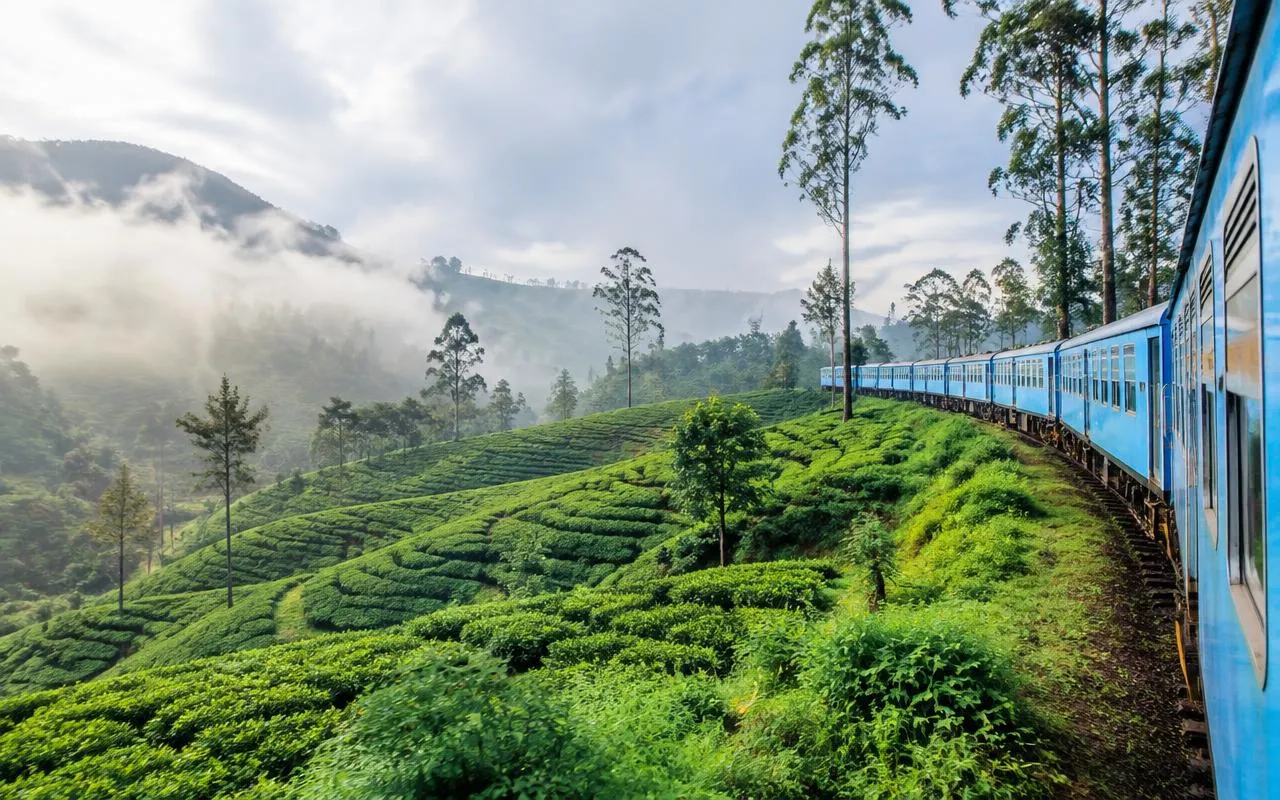
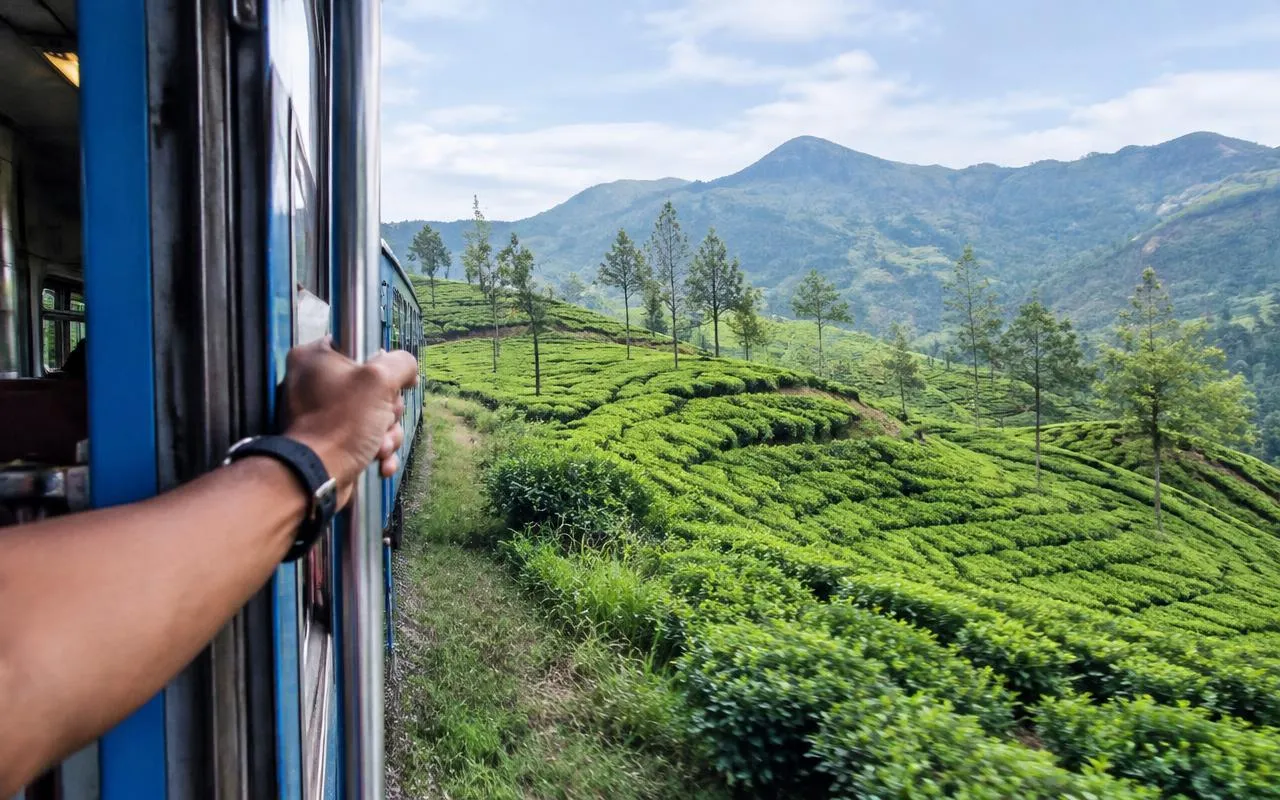
After Nawalapitiya and especially beyond Hatton, the hills grow steeper and the famous tea estates take over. Neat rows of bright green tea bushes cover entire slopes, interrupted only by shade trees, winding paths and the white walls of tea factories. If you look carefully, you may see pluckers working on the hillsides with baskets on their backs. This is the landscape that made Ceylon tea famous worldwide.
Waterfalls and cloud forest
Between Talawakele and Pattipola, the train passes waterfalls that tumble down ravines, sometimes right beside the track. The air grows noticeably cooler and clouds often roll across the line, wrapping the train in mist one minute and revealing a sunny valley the next. Pack a light jumper; the highest sections can feel surprisingly chilly.
The high plateau
Near Pattipola, the highest station on the network, the landscape opens into grasslands, pine and eucalyptus forest. This is the edge of Horton Plains National Park. Shortly afterwards the train passes through long tunnels, which local children love to cheer in, before the views become truly dramatic around Ohiya and Idalgashinna, where the land falls away towards the southern plains.
Haputale and the descent to Ella
Haputale sits on a narrow ridge, and on clear days you can see far across the lowlands. After Bandarawela, the line begins its descent, passing the famous loop at Demodara, where the railway spirals beneath itself, and then crossing the Nine Arch Bridge shortly before arriving in Ella.
Best time to ride the Kandy to Ella train
The hill country can be visited all year, but the weather affects both the views and the reliability of the line.
**December to March** is generally the driest and clearest period in the central highlands, with crisp mornings and good visibility. It is also the busiest season, so book early.
**April** can be lovely but is a popular local holiday period around the Sinhala and Tamil New Year, which makes trains extra busy.
**May to September** brings the southwest monsoon to parts of the island. The hill country sees more cloud and showers, especially on the western slopes, but it is also greener and quieter.
**October and November** are often the wettest months in the hills, with heavier rain that can occasionally disrupt the line.
Mist and showers can happen in any season, and they are part of the experience. Even on cloudy days the light over the tea estates is beautiful. If clear views are your priority, ride in the morning, when the skies are usually clearer before afternoon clouds build up.
Arriving in Ella: what to do first
Ella station is small and charming, with flower beds and a classic colonial-era building. The village centre is only a short walk away, and tuk-tuks wait outside to take you to guesthouses on the surrounding hillsides. Ella is compact, relaxed and full of cafés, so it is easy to settle in.
Nine Arch Bridge
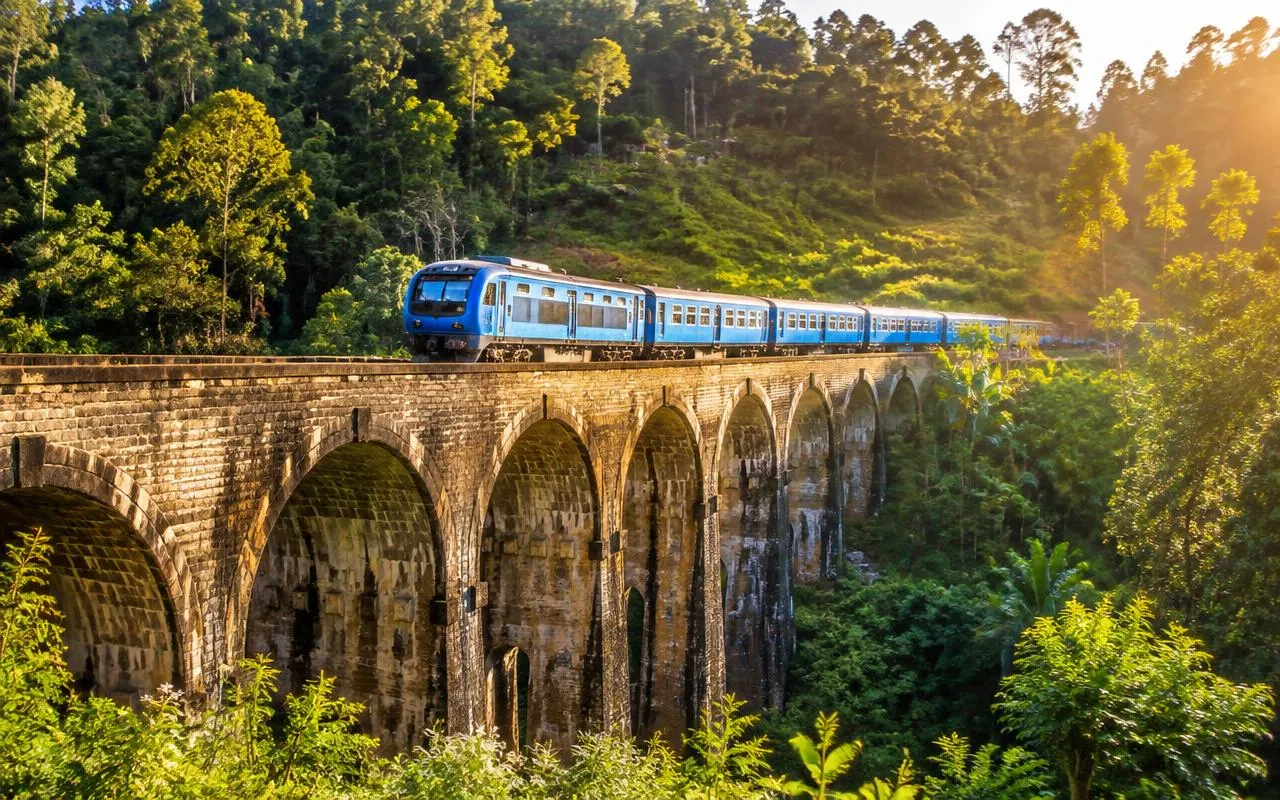
The Nine Arch Bridge is one of the most photographed places in Sri Lanka. Built during the colonial era and completed in the early twentieth century, it spans a jungle-covered ravine on tall stone and brick arches. You can walk to the bridge from Ella in about forty minutes along the railway line or quiet paths, or take a tuk-tuk to the nearest point and walk the final stretch down.
The best moment is watching a train cross. Ask locally for approximate train times, then arrive early to find a good spot on the hillside viewpoints. Be extremely careful if you walk on or near the tracks; trains are slow but they still come, and there is very little space on the bridge itself.
Ravana Falls and tea factories
Ravana Falls is a short drive below Ella and is most impressive after rain. Several tea estates near Ella and Haputale offer factory tours where you can watch the leaves being withered, rolled, dried and sorted, then taste the result. For more ideas on where to sip and relax, read our guide to coffee shops in Ella.
A sample three-day itinerary: Kandy to Ella
This simple plan works well for first-time visitors.
Day 1: Kandy
Explore the Temple of the Sacred Tooth Relic, walk around Kandy Lake and visit the Royal Botanical Gardens at Peradeniya. In the evening, watch a traditional Kandyan dance show. Buy snacks and water for the next day's train and confirm your departure station and time.
Day 2: The train to Ella
Catch the morning train, ideally starting from Kandy so you can secure your seat. Spend the day watching the tea country, waterfalls and highlands roll past. Enjoy station snacks, chat to fellow passengers and take turns at the doorways. Arrive in Ella in the late afternoon, check in and have dinner in the village.
Day 3: Ella
Rise early for Little Adam's Peak, then walk to the Nine Arch Bridge to watch a train cross. After lunch, visit a tea factory or Ravana Falls. Relax in one of Ella's cafés as the sun sets over the hills.
From Ella, many travellers continue south to the coast. It is a few hours by road to the beaches of the south, and many combine it with a safari. See our guides to Yala National Park, the South Coast of Sri Lanka and Galle Dutch Fort, or read our complete Sri Lanka travel guide and the hill country guide for a full itinerary.
What to pack for the journey
**Snacks and water.** Vendors sell food, but bring a bottle of water and some easy snacks in case of delays.
**A warm layer.** The highest sections are cool, especially in the morning or in cloudy weather.
**A light rain jacket.** Showers can arrive suddenly in the hills.
**Small bills and coins.** Useful for vendors, tuk-tuks and station toilets.
**A small daypack.** Keep valuables, passport, phone and charger close to you.
**Light luggage.** Racks are small, and moving large suitcases through crowded carriages is difficult.
**Downloaded entertainment and offline maps.** Mobile coverage is patchy in tunnels and remote valleys.
**Tissues and hand sanitiser.** Train toilets are basic.
Safety and etiquette on the train
The Kandy to Ella train is generally safe and friendly, but a few sensible habits will keep the day enjoyable for everyone.
Doorway photos
Hanging out of the open doors for photos has become a famous image of this journey, but it carries real risk. Trains pass close to rock cuttings, poles, vegetation and tunnel walls, and accidents have happened. If you stand in a doorway, keep a firm grip with both hands, stay mostly inside the carriage, never lean far out and never sit on the step. Watch for tunnels and bridges ahead. A good photo is never worth an injury.
Respect local passengers
Remember that for many people on board, this is their daily commute. Do not block doorways for long periods, offer your seat to elderly passengers, monks, pregnant women and parents with small children, and keep your music on headphones. Ask before photographing people, especially children.
Frequently asked questions
Does the Kandy to Ella train stop at Nuwara Eliya?
Not directly. The nearest station is Nanu Oya, about twenty minutes from Nuwara Eliya by road. Tuk-tuks and buses connect the two.
Which side is best on the Kandy to Ella train?
Many travellers prefer the right-hand side when heading towards Ella and the left-hand side when heading back to Kandy, but the line curves constantly, so you will see great views from both sides.
Sources
Source: https://railway.gov.lk/
Source: https://seatreservation.railway.gov.lk/
Source: https://www.srilanka.travel/