
Paris Travel Guide: Where to Stay, What to See and How to Plan
20 October 2026 · 15 min read
Paris has been drawing travellers for centuries, and it rarely disappoints. The French capital combines world-famous landmarks with quiet neighbourhood squares, grand museums with tiny bakeries, and wide boulevards with cobbled lanes that seem unchanged for generations. This guide is for first-time visitors who want a clear plan: when to go, how to get around, which neighbourhoods to stay in, what to see, how to eat well, how to manage costs, and how to avoid the common mistakes that make a Paris trip more stressful than it needs to be.
Why visit Paris
Few cities pack so much into such a compact area. The historic centre along the Seine, from the Louvre to the Eiffel Tower, is listed by UNESCO as a World Heritage Site, recognised for the way its riverside architecture records the city's evolution from the Middle Ages to the twentieth century. Within walking distance you can see Gothic cathedrals, royal palaces, nineteenth-century bridges and modern landmarks.
Paris is also a living city rather than an open-air museum. Locals shop at street markets, linger over coffee on café terraces and picnic beside canals. The best trips balance the big sights with time simply wandering, sitting and watching daily life unfold.
Best time to visit Paris
Paris is a year-round destination, and each season has its own character.
Spring, roughly April to June, is many people's favourite time. Parks bloom, café terraces fill up and temperatures are pleasant for walking. It can be showery, so pack a light waterproof.
Summer, from July to August, brings long days and warm, sometimes hot, weather. Many Parisians leave the city in August, so some small shops and restaurants close, while popular sights remain busy with visitors. Summer festivals, open-air cinema and riverside events add atmosphere.
Autumn, from September to November, offers mild weather in the early weeks, golden trees in the parks and a lively cultural calendar as the city returns from holidays. It is an excellent time for museums and food.
Winter, from December to February, is cold and often grey, but crowds are thinner, hotel prices can be lower, and the city sparkles with festive lights and seasonal markets in December.
For the best balance of weather and crowds, consider late April to June, or September to October.
Getting to Paris
Paris has two main international airports. Charles de Gaulle, north-east of the city, handles most long-haul flights. Orly, to the south, serves many European and some international routes. Some low-cost airlines use Beauvais, which is much further away.
From Charles de Gaulle, the RER B suburban train runs into central Paris, and there are express buses and taxis with fixed fares to the city. From Orly, the Orlyval shuttle connects to the RER B, and metro line 14 also links the airport to the centre. Taxis from both airports charge regulated flat fares to central Paris, so use the official taxi ranks and avoid people offering rides inside the terminal.
Paris is also well connected by high-speed rail. Eurostar trains from London arrive at Gare du Nord, while TGV and other trains link Paris with cities across France and neighbouring countries. The city has several major stations, so check which one your train uses.
Getting around Paris
Paris is one of the most walkable cities in the world, and many of its pleasures are found on foot. For longer distances, the public transport network is excellent.
The metro has many lines and stations close together, so you are rarely far from a stop. The RER suburban trains cross the city faster and reach places such as Versailles and the airports. Buses are slower but scenic. Tickets and passes can be bought at stations and through official apps, and options change from time to time, so check the official RATP and Île-de-France Mobilités websites for current fares and passes before you travel.
Paris also has a large public bike-sharing system called Vélib', and an expanding network of cycle lanes. Riverside paths along the Seine are particularly pleasant for cycling and walking.
Taxis and ride-hailing services are widely available but can be slow in traffic. For most journeys, the metro is quicker.
Understanding the arrondissements
Paris is divided into twenty districts called arrondissements, which spiral outwards from the centre like a snail shell. The first arrondissement contains the Louvre, and numbers rise clockwise. Addresses and postcodes end with the arrondissement number, so 75004 is the fourth. Knowing this makes it much easier to understand where things are.
Where to stay in Paris
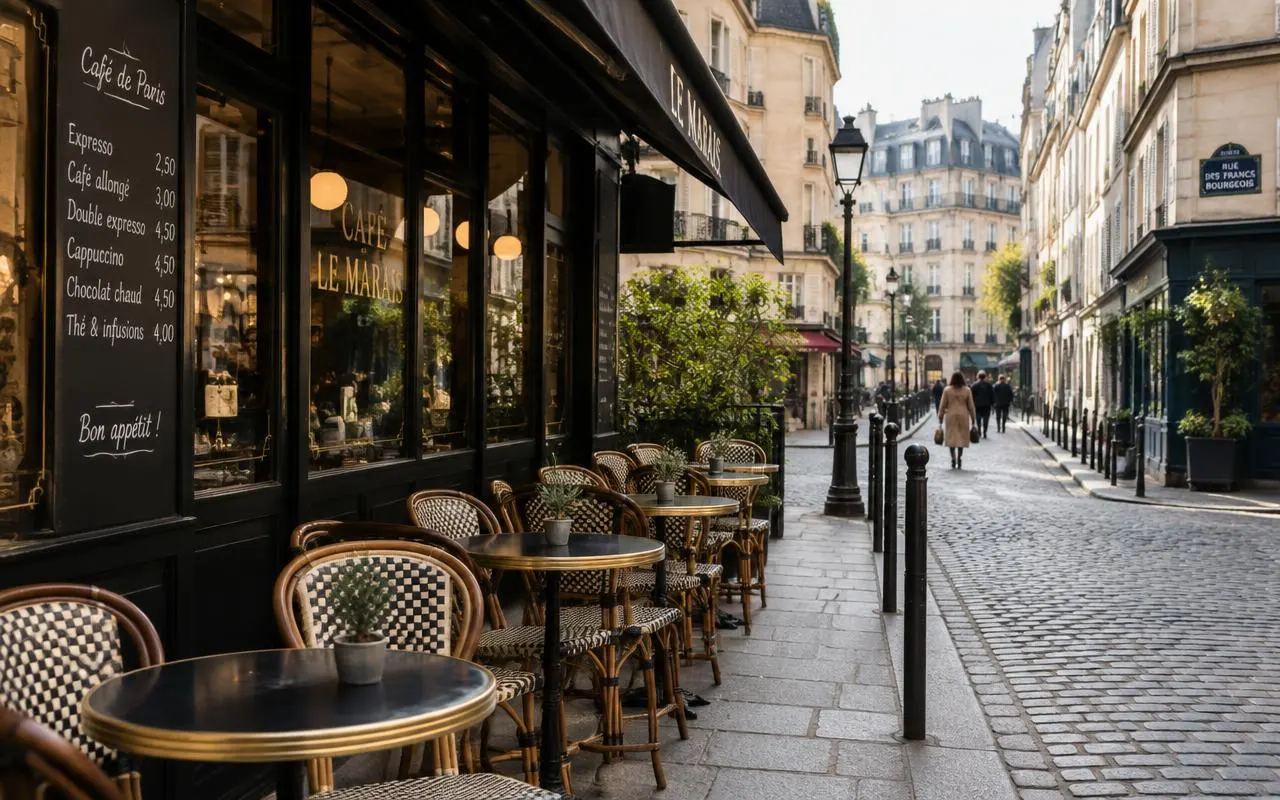
Le Marais, spread across the third and fourth arrondissements, is a favourite for first-time visitors. It has medieval lanes, elegant mansions, boutiques, galleries, falafel shops and lively bars, and it is central for sightseeing.
Saint-Germain-des-Prés and the Latin Quarter, on the Left Bank in the sixth and fifth, are classic Paris: literary cafés, bookshops, the Luxembourg Gardens and a gentle, elegant atmosphere. The Latin Quarter tends to be a little more affordable and student-focused.
The area around the Louvre and Opéra in the first, second and ninth arrondissements is very central, with grand department stores and excellent transport links.
The seventh arrondissement, near the Eiffel Tower, is calm and residential, with views and quiet streets, though evenings can be sleepy.
Montmartre in the eighteenth has village charm, artists' squares and hilltop views, and hotels are often cheaper, though it is further from the centre and hilly.
Canal Saint-Martin and the tenth and eleventh arrondissements have a younger, creative feel with independent cafés, wine bars and good-value restaurants.
For a first visit, choose somewhere central and close to a metro station. You will save time and energy every day.
Top things to see in Paris
The Eiffel Tower
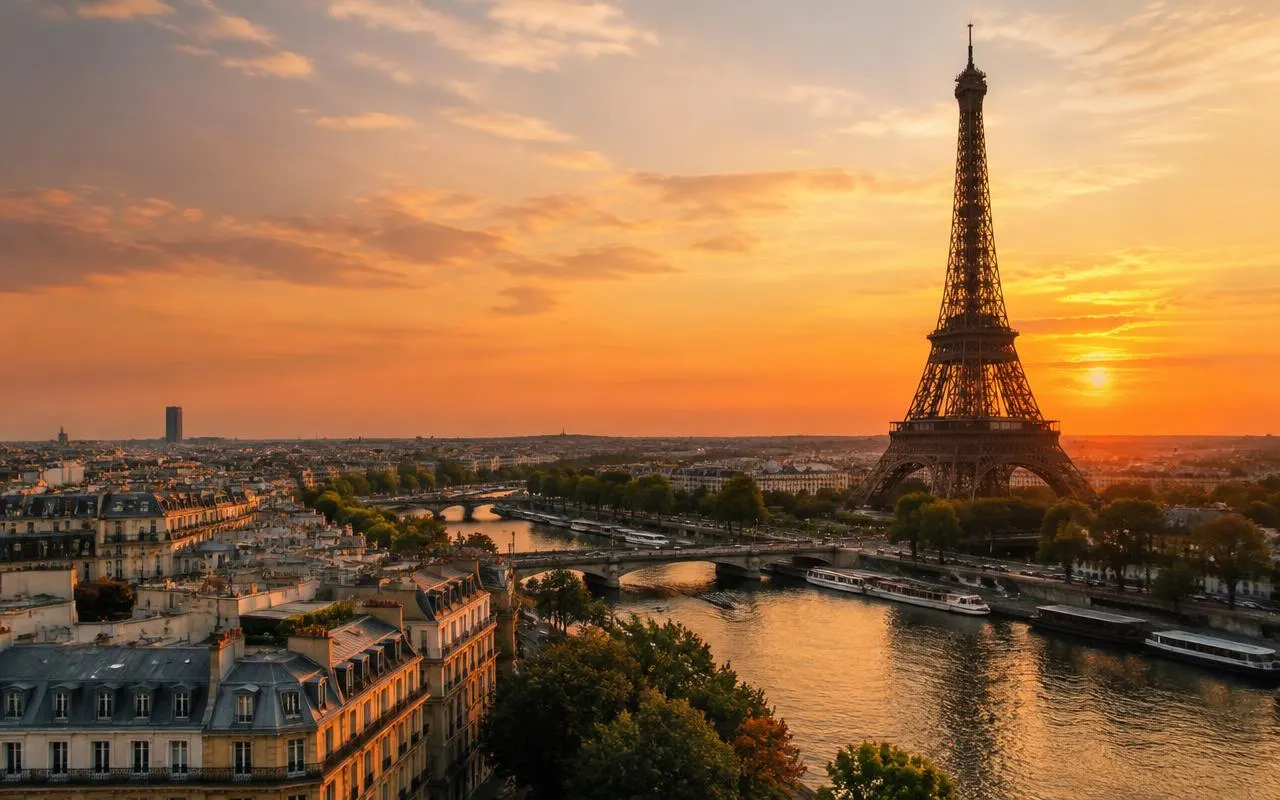
Built by Gustave Eiffel's company for the 1889 World's Fair, the tower was criticised by some artists at the time but became the symbol of the city. You can climb the stairs to the second floor or take lifts to the top. Book tickets in advance through the official website to reduce queues. For the classic view of the tower itself, head to the Trocadéro gardens across the river or the Champ de Mars park at its foot. After dark, the tower sparkles with lights for a few minutes at the start of each hour.
The Louvre
Once a royal palace, the Louvre is now one of the largest and most visited museums in the world. Its collection ranges from ancient Egyptian and Greek antiquities to European paintings, including the Mona Lisa and the Venus de Milo. It is impossible to see everything in one visit, so choose a few sections in advance. Booking a timed entry slot is strongly recommended, and arriving early or visiting on a late-opening evening helps avoid the busiest periods.
Notre-Dame Cathedral and Île de la Cité
Notre-Dame, a masterpiece of Gothic architecture, was badly damaged by fire in 2019 and reopened to the public in December 2024 after an extensive restoration. Nearby on the same island is Sainte-Chapelle, a thirteenth-century royal chapel with breathtaking stained-glass windows, best seen on a sunny day. The Conciergerie, a former palace and prison, tells the story of the French Revolution.
Musée d'Orsay
Housed in a former railway station on the Left Bank, the Musée d'Orsay holds an outstanding collection of Impressionist and Post-Impressionist art, including works by Monet, Renoir, Degas, Van Gogh and Cézanne. Its giant station clock is a favourite photo spot.
Montmartre and Sacré-Cœur
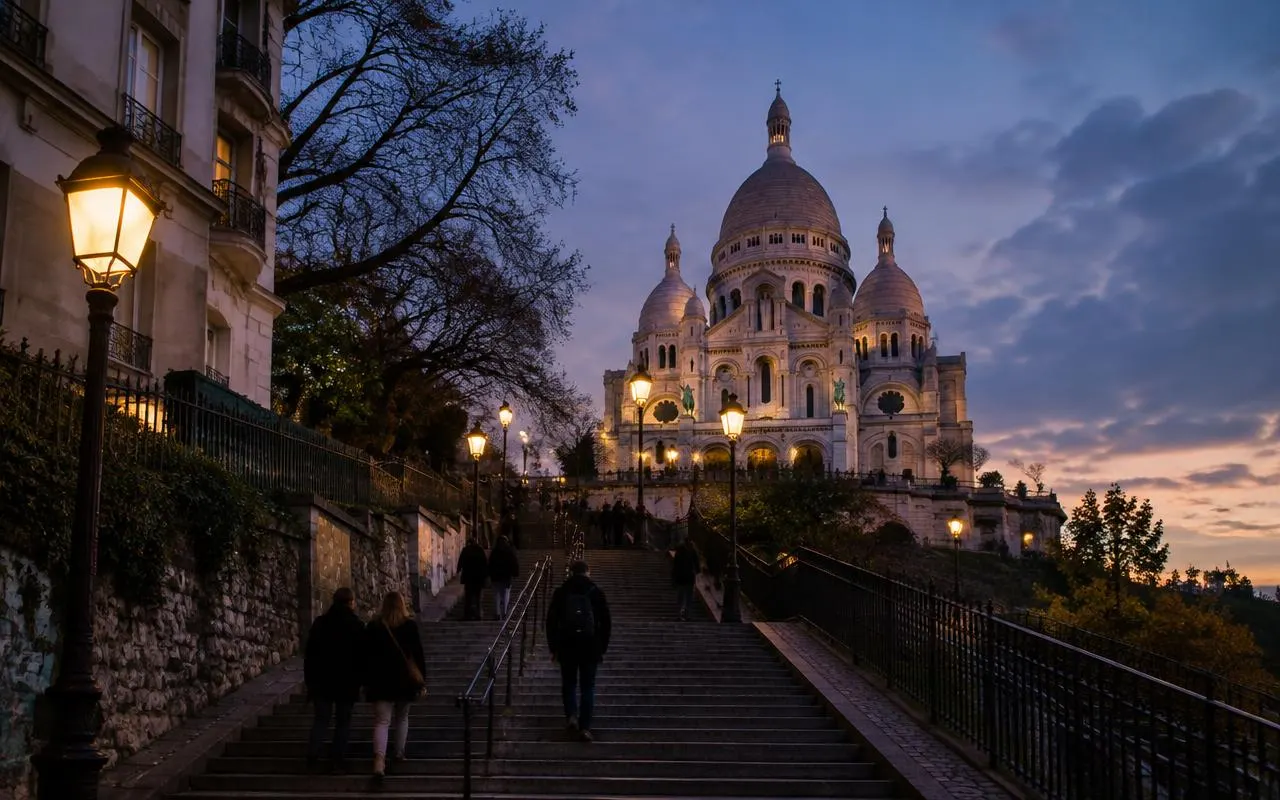
Montmartre, on a hill in the north of the city, was home to artists such as Picasso and Toulouse-Lautrec. Today you can climb the steps to the white-domed Sacré-Cœur Basilica for sweeping views, browse the painters at Place du Tertre, and wander quieter streets with vineyards and old windmills. Keep an eye on your belongings around the basilica steps, where pickpockets and pushy sellers operate.
Arc de Triomphe and the Champs-Élysées
The Arc de Triomphe honours those who fought for France and stands at the top of the Champs-Élysées. You can climb to the rooftop for a striking view down the avenues radiating from the arch. Use the underground passage to reach it, never try to cross the busy roundabout.
Gardens and parks
Paris has wonderful green spaces. The Luxembourg Gardens are elegant and relaxing, with fountains, chairs and a puppet theatre. The Tuileries Garden connects the Louvre to Place de la Concorde. The Jardin des Plantes offers botanical greenhouses and a small zoo, while Parc des Buttes-Chaumont, in the east, has dramatic cliffs and a hilltop temple.
Other museums worth your time
The Musée de l'Orangerie displays Monet's immense Water Lilies panels. The Centre Pompidou is known for modern art and its bold inside-out architecture, though it has announced a long closure for renovation, so check before visiting. The Rodin Museum has sculptures in a beautiful garden, and the Musée Picasso and Musée Carnavalet, the history museum of Paris, are both in the Marais.
Day trip to Versailles
The Palace of Versailles, a short train ride from central Paris, was the seat of royal power before the Revolution. Its Hall of Mirrors, royal apartments and vast gardens are spectacular. Book timed tickets in advance, arrive early, and allow a full day if you want to explore the gardens and the Trianon estate.
A Seine river cruise
A boat trip on the Seine is a relaxing way to see many landmarks, especially at sunset or after dark when bridges and buildings are lit. Several companies run regular sightseeing cruises from near the Eiffel Tower and Notre-Dame.
A sample four-day Paris itinerary
Day one: start at Notre-Dame and Sainte-Chapelle on Île de la Cité, cross to the Latin Quarter for lunch, then walk through the Luxembourg Gardens to Saint-Germain. End with a sunset river cruise.
Day two: visit the Louvre in the morning, stroll through the Tuileries, see the Orangerie, then walk up the Champs-Élysées to the Arc de Triomphe. In the evening, watch the Eiffel Tower sparkle from Trocadéro.
Day three: spend the morning at the Musée d'Orsay, then go up the Eiffel Tower in the afternoon. In the evening, explore the Marais, its squares and its restaurants.
Day four: take a day trip to Versailles, or spend the morning in Montmartre and the afternoon along Canal Saint-Martin.
With more time, add markets, neighbourhood walks, smaller museums and a second day trip, such as Giverny for Monet's garden.
Eating and drinking in Paris
Food is one of the great joys of Paris. Start the day with a croissant or pain au chocolat from a local boulangerie, and pick up a fresh baguette for a picnic. At lunch, many restaurants offer a set menu called a formule, which is usually better value than ordering from the evening menu.
Classic dishes to try include steak frites, duck confit, onion soup, croque-monsieur, coq au vin and a well-made omelette. For dessert, look for crème brûlée, tarte tatin, macarons and éclairs. A cheese course with good bread is a simple pleasure.
Traditional bistros and brasseries are everywhere, but the best meals are often found away from the main sights. Look for menus written in French with a short list of seasonal dishes, and book ahead for popular restaurants, especially at dinner.
Street markets such as Marché d'Aligre and the covered Marché des Enfants Rouges are great places to try local produce and grab lunch. Food halls and wine bars are also popular for casual eating.
Café etiquette is simple: a coffee at the counter is often cheaper than one at a table, and you can sit for a long time without being rushed. Service is included in French restaurant prices, though leaving small change or rounding up for good service is appreciated.
Costs and money-saving tips
Paris has a reputation as an expensive city, and hotels in particular can be costly in peak periods. There are ways to keep costs manageable.
Stay slightly outside the most famous areas but close to a metro line. Eat lunch at restaurants offering a set menu, and enjoy picnics in parks. Many museums offer free entry to young people from the European Union and to everyone on certain days, and some city museums have free permanent collections. A museum pass can save money and time if you plan to visit several museums in a short period, so compare it with buying individual tickets.
Walking is free and often the best way to discover the city, and public transport is good value compared with taxis.
The currency is the euro, and cards are widely accepted. Contactless payment is common, but carry some cash for small purchases and markets.
Safety in Paris
Paris is generally safe for visitors, but pickpocketing is common in crowded places, including the metro, around major landmarks and at busy stations. Keep bags closed and in front of you, avoid putting phones on café tables, and be cautious of people who approach with petitions, rings or bracelets as a distraction.
At night, central areas are usually lively and well lit, but use normal city precautions, especially late at night around large stations. Save the European emergency number, 112, in your phone.
Etiquette and local customs
A little politeness goes a long way in Paris. Always greet shopkeepers and staff with bonjour when you enter, and say merci and au revoir when you leave. It is considered rude to start a conversation without greeting someone first.
Parisians tend to speak quietly in public, especially on transport and in restaurants. Dress codes are relaxed, but locals often dress neatly, and smart-casual clothing helps you blend in. In churches, keep voices low and dress respectfully.
Learning a few basic French words, such as s'il vous plaît for please and excusez-moi for excuse me, will be appreciated, even if the conversation switches to English.
Responsible travel in Paris
Use public transport, walk and cycle rather than taking taxis. Support independent bakeries, cafés and shops. Visit popular sites early or late in the day to spread visitor numbers, and explore less visited neighbourhoods. Bring a reusable bottle and fill it at the city's public drinking fountains, including the green Wallace fountains found across Paris.
Practical tips
Book tickets for the Eiffel Tower, the Louvre, Versailles and other major sites well in advance, especially in spring and summer. Many museums close one day a week, typically Monday or Tuesday, so check opening days when you plan your itinerary.
Pack comfortable walking shoes, a light rain jacket and layers. France uses two-pin European plugs. Free Wi-Fi is available in many public places, but a local or European eSIM makes navigation easier.
Paris markets and shopping
Shopping in Paris goes far beyond luxury fashion. The grand department stores on Boulevard Haussmann, Galeries Lafayette and Printemps, are worth visiting for their architecture alone; Galeries Lafayette has a spectacular stained-glass dome and a free rooftop terrace with views across the city. For independent boutiques, concept stores and vintage clothing, wander the streets of the upper Marais.
The flea market at Saint-Ouen, just beyond the northern edge of the city, is one of the largest antiques markets in the world, with hundreds of dealers selling furniture, art, vintage fashion and curiosities. Even if you buy nothing, it is a fascinating place to spend a weekend morning.
Food shopping is a pleasure in itself. Look for specialist shops selling cheese, chocolate, pastries, tea and wine, and pick up edible souvenirs such as mustard, salted butter caramels or a tin of good sardines. Along the Seine, the green boxes of the bouquinistes, the riverside booksellers, have sold second-hand books, prints and postcards for centuries.
Paris after dark
Evenings are a highlight of any visit. Many museums open late on at least one night a week, which is a quieter time to see famous works. The Opéra Garnier, a lavish nineteenth-century opera house, stages ballet and opera, and daytime visits let you admire its grand staircase and painted ceiling. Classical concerts are held in historic churches, and jazz clubs in the Latin Quarter and around Châtelet continue a long tradition.
For a simple, memorable evening, buy a bottle of wine and some cheese and join locals along the banks of the Seine or Canal Saint-Martin as the light fades. Walking across the Pont Neuf or Pont Alexandre III at night, with monuments lit up around you, is one of the city's free pleasures.
Travelling with children
Paris is a good destination for families. The Jardin d'Acclimatation in the Bois de Boulogne offers rides, gardens and play areas, while the Cité des Sciences et de l'Industrie at La Villette is a large, hands-on science museum. Children usually love the carousels found around the city, the puppet shows and toy sailing boats in the Luxembourg Gardens, and the natural history galleries at the Jardin des Plantes. Many museums are free for under-eighteens, and the metro is manageable with a lightweight stroller, although many stations have stairs rather than lifts.
Frequently asked questions
How many days do you need in Paris? Three to four days covers the main highlights at a comfortable pace, while a week allows day trips and slower neighbourhood exploration.
What is the best area to stay in Paris for first-time visitors? Le Marais, Saint-Germain-des-Prés and the Latin Quarter are excellent choices because they are central, attractive and well connected.
Is Paris expensive? It can be, particularly for hotels, but set lunch menus, picnics, public transport and free sights help keep costs down.
Do I need to speak French? No, many people in tourist areas speak some English, but basic French greetings are appreciated.
What is the best time to visit Paris? Spring and early autumn usually offer the best mix of pleasant weather and manageable crowds.
Final thoughts
Paris rewards curiosity, and it rewards patience too, because the city reveals itself slowly to curious, patient visitors. See the great monuments, but leave time for an unplanned walk, a slow lunch or a bench in a quiet square. Those small moments are often the ones you remember most.
Sources
Source: https://whc.unesco.org/en/list/600/
Source: https://parisjetaime.com/eng/
Source: https://www.toureiffel.paris/en
Source: https://www.louvre.fr/en
Source: https://www.ratp.fr/en