
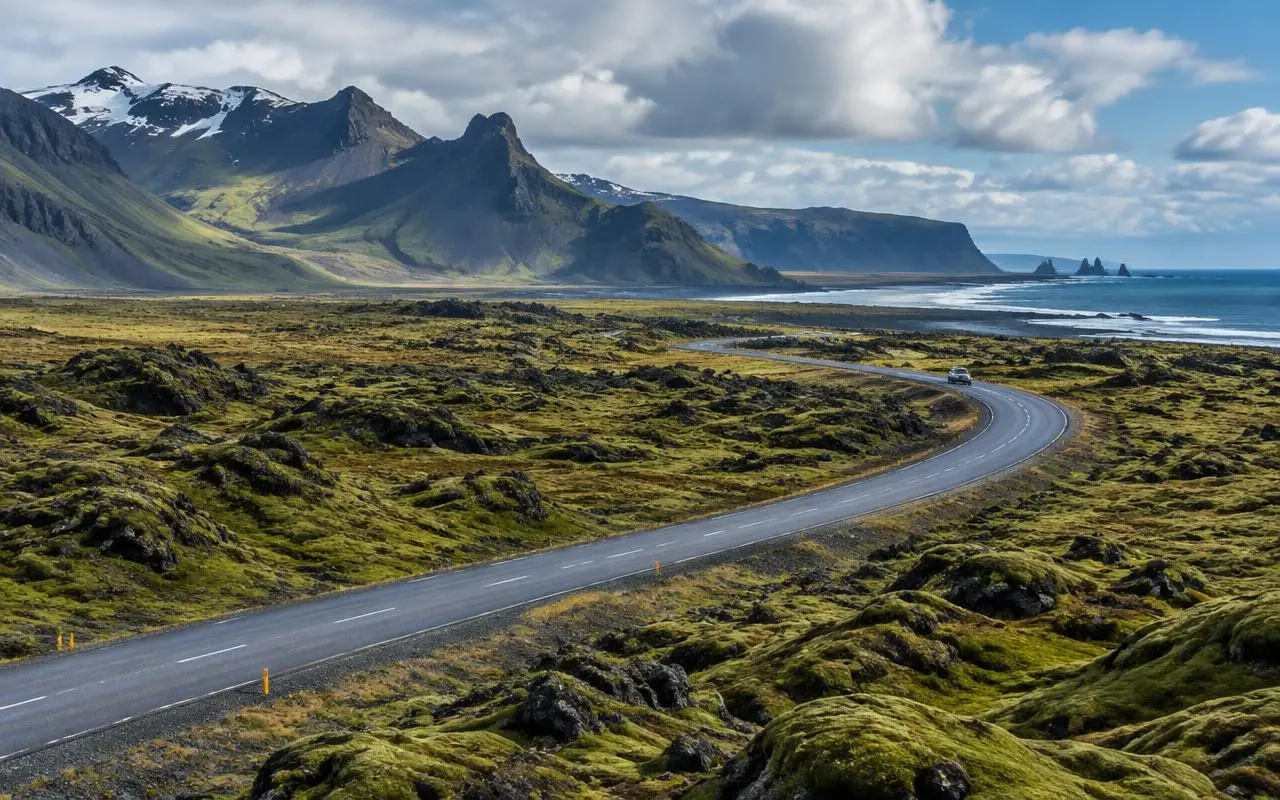
Iceland Ring Road Itinerary: 7 and 10 Day Self-Drive Guide
3 October 2026 · 5 min read
Iceland’s Ring Road — Route 1 — loops roughly 1,322 kilometres around the island, linking black-sand beaches, glaciers, volcanoes, fjords and tiny fishing villages. It looks simple on a map, but a successful trip is shaped by daylight, wind and how much time you spend out of the car. This guide gives you a realistic day-by-day itinerary for 7 and 10 days, a route overview you can follow on any map, and honest advice about seasons, winter driving and safety.
How many days do you need for the Ring Road?
You can technically drive the full loop in about 12 to 13 hours of pure driving, but that leaves no time to stop. Most travellers should plan for a minimum of 7 days, which allows one or two proper stops per day and a sensible daily driving distance. Ten days is the sweet spot: it adds the Snæfellsnes Peninsula, gives you slack for bad weather, and turns the trip from a checklist into a holiday. If you only have 4 or 5 days, do not attempt the full circle — focus on the South Coast as far as Jökulsárlón glacier lagoon and return to Reykjavík instead.
Iceland Ring Road map: the route at a glance
Route 1 is a single paved ring, so navigation is easy: you are either going clockwise or anti-clockwise. Most people drive anti-clockwise from Reykjavík, tackling the famous South Coast first. The classic stops, in that order, are:
Reykjavík and the Golden Circle (Þingvellir National Park, the Geysir geothermal area and Gullfoss waterfall) → Seljalandsfoss and Skógafoss waterfalls → the black-sand beach at Reynisfjara near Vík → the mossy Eldhraun lava field → Skaftafell and Vatnajökull National Park → Jökulsárlón glacier lagoon and Diamond Beach → the East Fjords and Egilsstaðir → Dettifoss waterfall → Lake Mývatn and its geothermal area → Goðafoss waterfall → Akureyri, the northern capital → the Snæfellsnes Peninsula (on the 10 day route) → back to Reykjavík.
Save an offline map before you leave and mark fuel stations in the north and east, where distances between services grow.
7 day Iceland Ring Road itinerary
Day 1: Arrive in Reykjavík, pick up your rental car and drive the Golden Circle. Overnight near Selfoss or Hella.
Day 2: South Coast waterfalls. Walk behind Seljalandsfoss, climb the stairs beside Skógafoss, then continue to Reynisfjara beach near Vík. Respect the warning signs: the waves here are genuinely dangerous. Overnight in Vík or Kirkjubæjarklaustur.
Day 3: Cross the Eldhraun lava field to Skaftafell for a short glacier-view hike, then on to Jökulsárlón glacier lagoon and Diamond Beach. Overnight in Höfn.
Day 4: The East Fjords — a quieter day of coastal driving through small fishing villages. Overnight in Egilsstaðir.
Day 5: Detour to Dettifoss, Europe’s most powerful waterfall, then explore the Lake Mývatn area: pseudocraters, lava fields and the geothermal baths. Overnight near Mývatn or Akureyri.
Day 6: Goðafoss waterfall, then Akureyri for lunch and a stroll. Continue west through the Skagafjörður horse country. Overnight near Blönduós or Hvammstangi.
Day 7: Drive back to Reykjavík with time for the Reykjanes Peninsula or a lagoon visit before your flight.
10 day Iceland Ring Road itinerary
Follow the 7 day route but slow the middle down and add the west. Spend an extra night on the South Coast so you can add a glacier hike or ice-cave tour near Skaftafell, and an extra night in the East Fjords or at Mývatn so a stormy day does not break your schedule. Then, instead of driving straight back to Reykjavík on the final day, take two days for the Snæfellsnes Peninsula — often called Iceland in miniature for its glacier-capped volcano, black churches, sea cliffs and seal beaches. Kirkjufell, the arrowhead mountain near Grundarfjörður, is the peninsula’s most photographed stop. Ten days also gives you the freedom to swap days around when the weather turns, which it will.
Best time to drive the Ring Road
June to August brings the midnight sun, open highland roads, puffins and the fullest services — but also the highest prices and the busiest car parks, so book accommodation and rental cars well ahead. May and September are the shoulder-season favourites: long enough days, fewer crowds and lower prices, with a real chance of northern lights in September. October to April is winter driving season, covered below.
Driving the Ring Road in winter
A winter Ring Road trip is possible and magical — frozen waterfalls, snowy fjords and northern lights — but it demands respect. Daylight shrinks to around 4 to 5 hours in December, so plan short driving legs. Rent a 4x4 with studded winter tyres, check road.is and vedur.is every morning, and be ready to cancel a day entirely when a storm warning is issued. Some East Fjords passes and northern stretches close temporarily in bad weather. If you are not confident driving on ice and in strong wind, consider basing yourself in Reykjavík and the South Coast instead of attempting the full loop.
Practical tips for a safe self-drive trip
Keep to marked roads: off-road driving is illegal and damages fragile moss that takes decades to recover. Headlights are required at all times. Slow down for single-lane bridges, gravel sections and sheep near the road, and never stop in a traffic lane for a photograph — use designated pullouts. Hold car doors firmly in strong wind; doors ripped off hinges are a classic rental-insurance claim. Fuel up before remote stretches, especially in the north and east, and carry water, snacks and warm layers in the car. Check weather warnings and road conditions from the Icelandic authorities every day before setting off, and tell someone your route when heading into quieter areas. Finally, build slack into your plan: the best Ring Road itinerary is one you can adjust when Iceland asks you to slow down.
Sources: https://safetravel.is/driving/ · https://www.road.is · https://en.vedur.is